
What are the types of residential hybrid solar systems and commercial hybrid solar system?
Three types of residential hybrid solar systems and commercial hybrid solar system
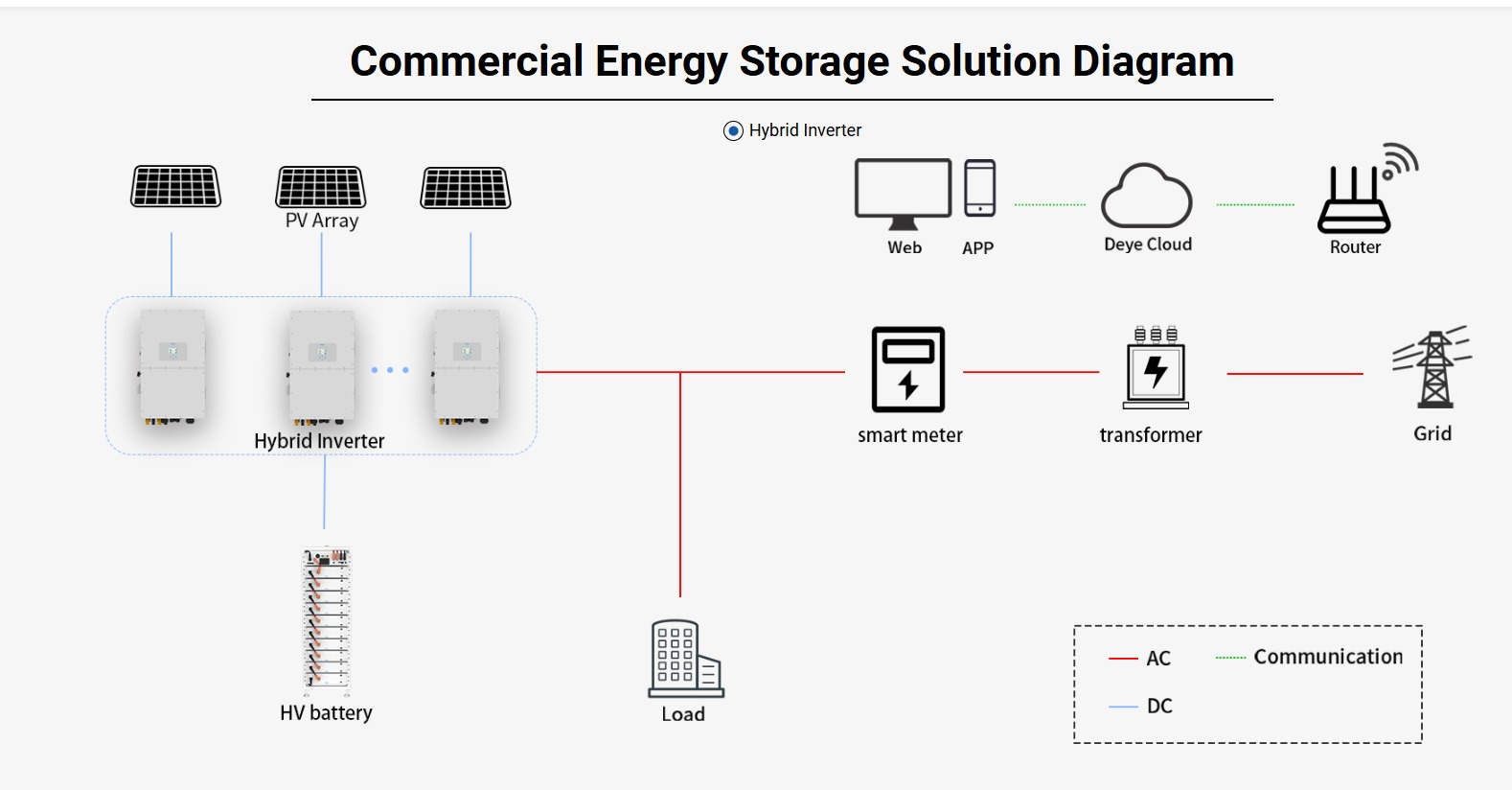 This is commercial hybrid solar energy storage system.
At the front end of the system, multiple PV arrays are connected to several hybrid inverters operating in parallel. The DC power generated by the solar panels is supplied to the hybrid inverters, which convert it into AC power for commercial loads. The inverters are also connected to a high-voltage battery system, allowing the batteries to be charged or discharged according to actual energy demand and improving the overall utilization of solar energy.
During the daytime, when solar generation is sufficient, the system gives priority to supplying power to the loads. Any excess solar energy can be stored in the high-voltage batteries. When solar generation is insufficient, electricity demand is high, or electricity prices are at peak levels, the batteries can discharge the stored energy. This reduces electricity consumption from the grid, supports peak shaving and load shifting, and helps lower overall energy costs.
A smart meter monitors the direction and amount of power flowing between the system and the utility grid in real time. Through the transformer, the system is connected to the public grid, enabling intelligent coordination among the PV system, battery storage, commercial loads, and the grid.
The system also supports remote monitoring and intelligent operation and maintenance. Through a router, it connects to the Deye Cloud platform. Users can access the system through a web portal or mobile app to monitor solar generation, battery status, load consumption, and grid power in real time. They can also adjust system settings, receive fault alarms, and analyze operating data.
Overall, this commercial hybrid solar and energy storage solution offers flexible expansion, intelligent energy management, remote monitoring, and significant energy-cost savings. It is suitable for factories, shopping centers, office buildings, and many other commercial and industrial applications.
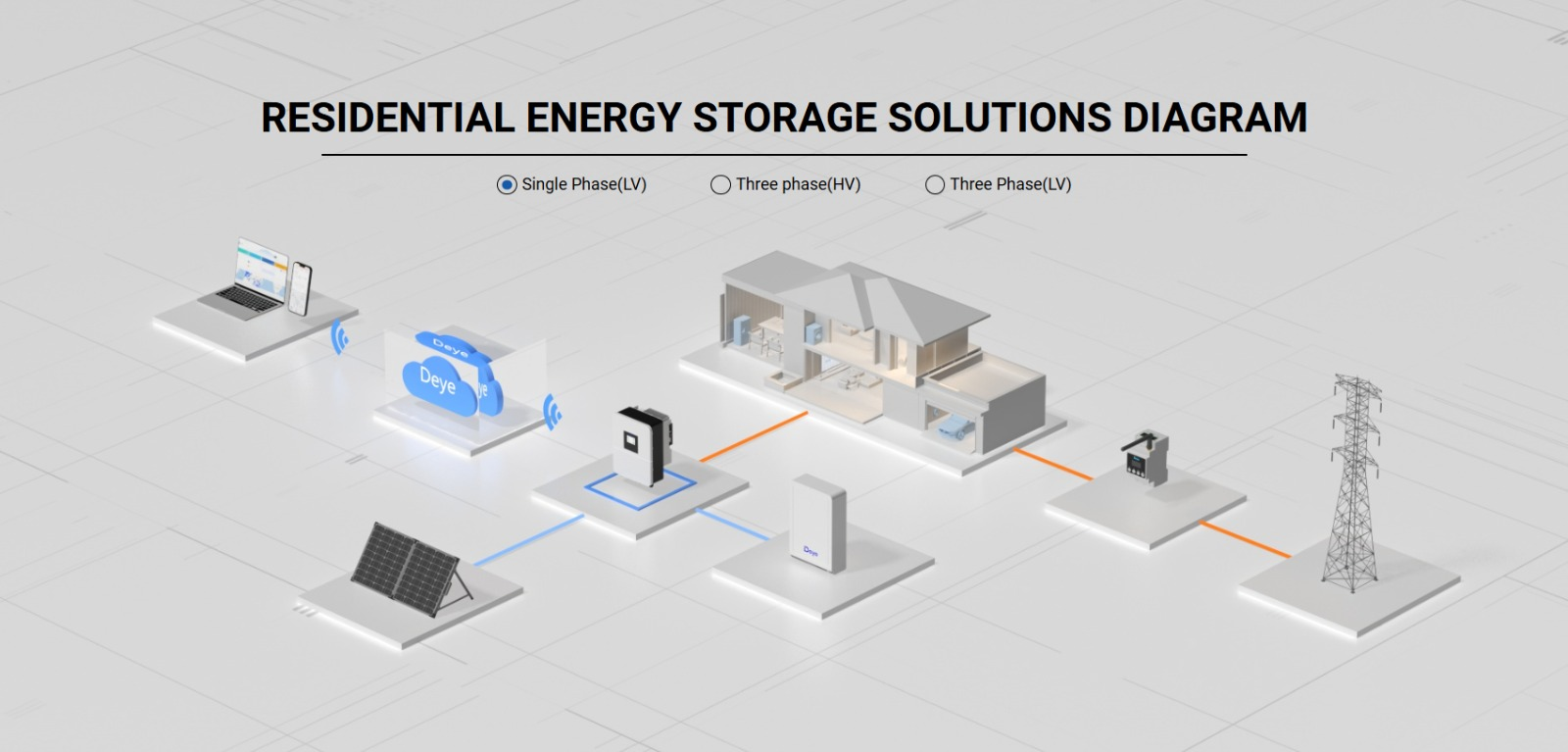
This is single-phase, low-voltage residential system
This diagram shows a typical single-phase, low-voltage residential system. The system mainly consists of solar panels, a hybrid inverter, a low-voltage battery, household loads, a smart meter, the utility grid, and a remote monitoring platform.
During the daytime, the solar panels generate DC electricity and send it to the hybrid inverter. The inverter converts the DC power into AC power for household appliances. Solar energy is given priority for home consumption, helping reduce the amount of electricity purchased from the grid.
When solar generation is higher than the household’s immediate demand, the surplus energy can be stored in the battery. In the evening, during cloudy weather, or when electricity demand increases, the battery releases the stored energy to supply the home. When both solar and battery power are insufficient, the system can automatically draw electricity from the utility grid to ensure a stable and continuous power supply.
The smart meter measures the power flow between the house and the grid in real time. Based on this information, the hybrid inverter intelligently manages solar generation, battery charging and discharging, household consumption, and grid power. Depending on local regulations and system settings, surplus solar energy may also be exported to the grid.
The system supports remote monitoring through the Deye Cloud platform. Homeowners can use a mobile phone or computer to check solar production, battery status, household consumption, and grid usage. They can also view historical data, receive system alarms, and manage operating settings remotely.
Overall, this residential energy storage solution improves solar self-consumption, reduces electricity costs, provides backup power during outages, and gives homeowners greater control over their energy use. In addition to the single-phase low-voltage configuration shown here, the solution can also support three-phase low-voltage and high-voltage systems to meet different residential requirements.
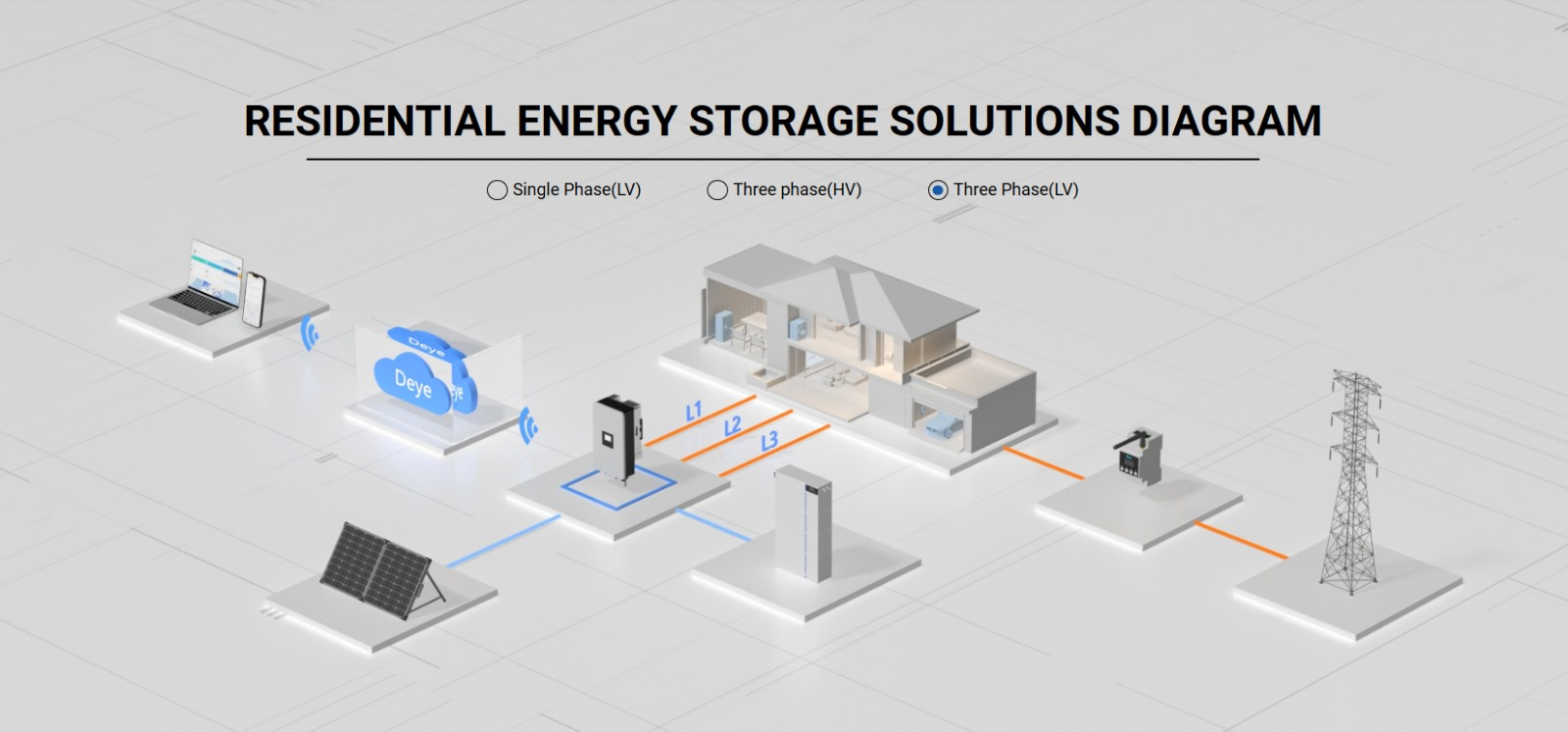
This is three-phase, low-voltage residential energy storage solution.
The system mainly consists of solar panels, a three-phase hybrid inverter, a low-voltage battery, household loads, a smart meter, the utility grid, and the Deye Cloud monitoring platform.
During the daytime, the solar panels generate DC electricity and send it to the hybrid inverter. The inverter converts the DC electricity into three-phase AC power—L1, L2, and L3—to supply different household loads. The system gives priority to using solar energy, which helps reduce electricity consumption from the utility grid.
When solar generation exceeds the home’s immediate energy demand, the surplus electricity can be stored in the low-voltage battery. During the evening, in cloudy conditions, or when household demand increases, the battery can discharge and provide additional power. When solar and battery energy are insufficient, the system automatically draws electricity from the grid to maintain a stable power supply.
Compared with a single-phase solution, the three-phase system can distribute power across all three phases, making it more suitable for larger homes and residences with high-power appliances, such as heat pumps, electric vehicle chargers, air-conditioning systems, and other three-phase equipment. Proper three-phase power management can also improve load balance and overall system efficiency.
The smart meter monitors the power flow between the house and the utility grid in real time. Based on this information, the hybrid inverter intelligently coordinates solar generation, battery charging and discharging, household consumption, and grid power. Depending on local regulations and system settings, surplus solar energy may also be exported to the grid.
The system can be connected to the Deye Cloud platform for remote monitoring and management. Users can check solar production, battery status, household consumption, three-phase operating data, and grid usage through a mobile phone or computer. They can also view historical data, receive fault notifications, and adjust system settings remotely.
Overall, this three-phase low-voltage residential solution provides intelligent energy management, higher solar self-consumption, lower electricity costs, flexible battery expansion, and a reliable household power supply. It is particularly suitable for large residential properties and homes with three-phase electrical systems.
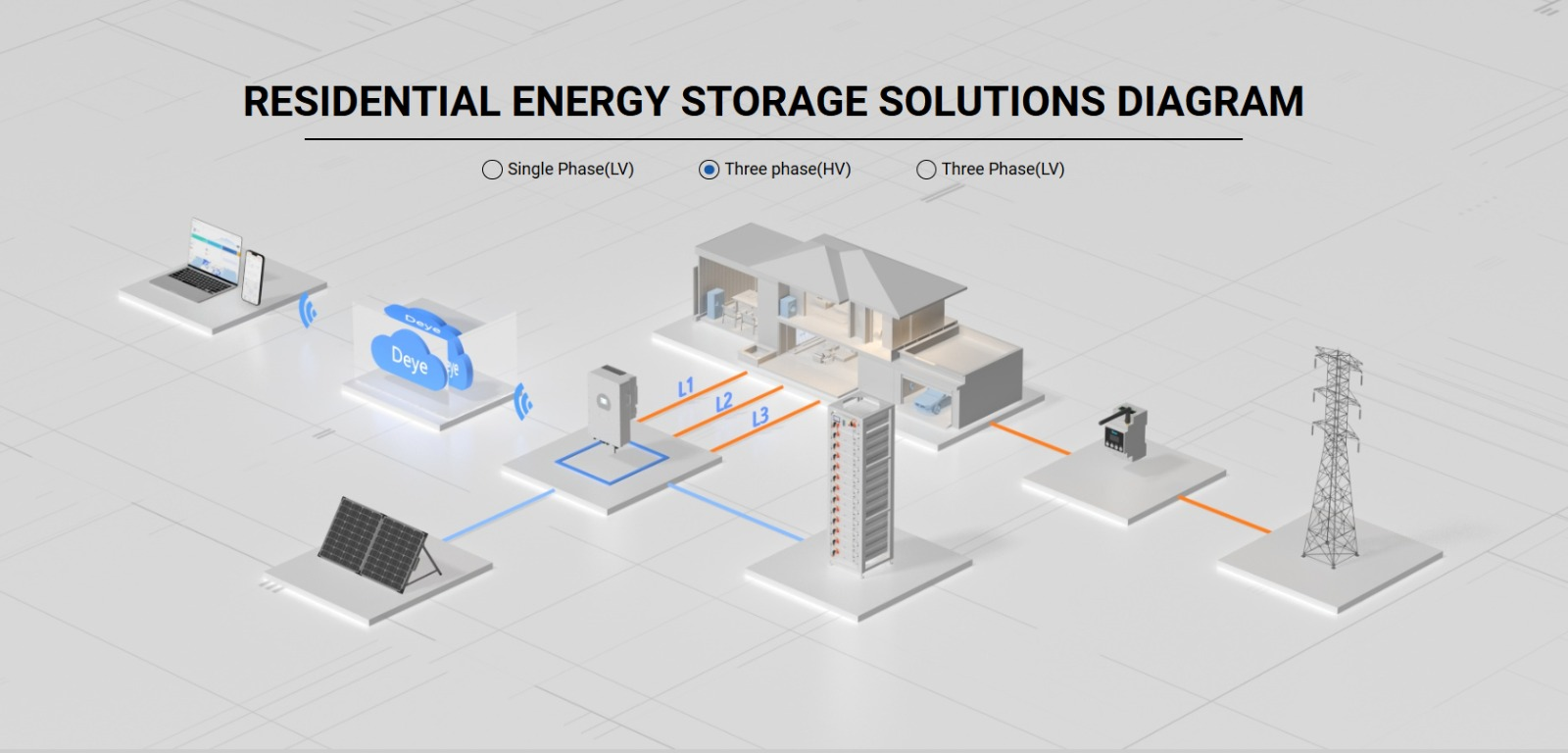
This is three-phase, high-voltage residential energy storage solution.
The system mainly consists of solar panels, a three-phase hybrid inverter, a high-voltage battery system, household loads, a smart meter, the utility grid, and the Deye Cloud remote monitoring platform.
During the daytime, the solar panels generate DC electricity and send it to the hybrid inverter. The inverter converts the DC electricity into three-phase AC power—L1, L2, and L3—to supply household appliances and other electrical loads. The system gives priority to solar energy, helping homeowners reduce their dependence on the utility grid.
When solar generation exceeds the home’s immediate electricity demand, the surplus energy is stored in the high-voltage battery. During the evening, in cloudy weather, or when household consumption increases, the battery releases the stored energy to support the loads. When solar and battery power are insufficient, the system automatically draws electricity from the grid to maintain a reliable and continuous power supply.
The high-voltage battery offers efficient energy conversion and is particularly suitable for higher-power residential applications. Its modular design also allows the storage capacity to be expanded according to the homeowner’s energy requirements.
Compared with a single-phase system, this three-phase solution distributes power across L1, L2, and L3. It is therefore suitable for larger homes and properties with high-power or three-phase equipment, such as heat pumps, electric vehicle chargers, air-conditioning systems, and swimming-pool equipment. Balanced three-phase power distribution can improve system stability and overall operating efficiency.
The smart meter monitors the power flow between the house and the utility grid in real time. Based on this information, the hybrid inverter intelligently manages solar generation, battery charging and discharging, household consumption, and grid power. Depending on local regulations and system settings, surplus solar energy may also be exported to the grid.
Through the Deye Cloud platform, users can remotely monitor solar production, battery status, household consumption, three-phase operating data, and grid usage from a mobile phone or computer. They can also review historical data, receive fault notifications, and manage system settings remotely.
Overall, this three-phase high-voltage residential energy storage solution provides efficient energy conversion, intelligent power management, flexible battery expansion, higher solar self-consumption, and lower electricity costs. It is an ideal solution for large residential properties with three-phase electrical systems and higher energy demands.